
Anastasia is staring at her bedroom ceiling. She is unsure exactly when the silence of sleep became the silence of the early morning, but she knows for sure that she is now awake. As she has aged, she has learnt to become more comfortable with this ever blurring line, the one that divides consciousness and unconsciousness.
Her dreams have increasingly echoed her past lived experiences. There, she feels as though she is young and strong again. Her waking hours on the other hand are becoming more dreamlike. Her vision is deteriorating, her movements are slowing, and her thoughts are clouded by an ever denser fog.
As the sensitivity of her youth fades she is becoming more guided by routine rather than reaction, but she still has enough control, for now, to live on her own terms. Today she follows her morning routine just as she has done so for decades. She wakes up on the same side of the bed, and begins preparing for the day. Like a ballerina dancing on stage she moves with purpose, practiced and silent.
She gets dressed, makes the bed, opens the blinds all the while careful to maintain the morning silence, even though it is not necessary anymore. It has been many years since her husband Stavro passed away but when they were younger this silence was critical. She was careful in the mornings not to wake him, and likewise, he would be careful at night not to wake her when he returned from his night shifts.
Over time they came to know through this routine that even as each of them slept, the other was always there caring for them. In a way it’s on this basis that they built their entire relationship. Whether apart physically or even consciously they always knew that they were never alone and that they were always cared for. So even now that Stavro won’t ever wake up, Anastasia still follows her morning routine in silence, careful to preserve Stavro’s peace.
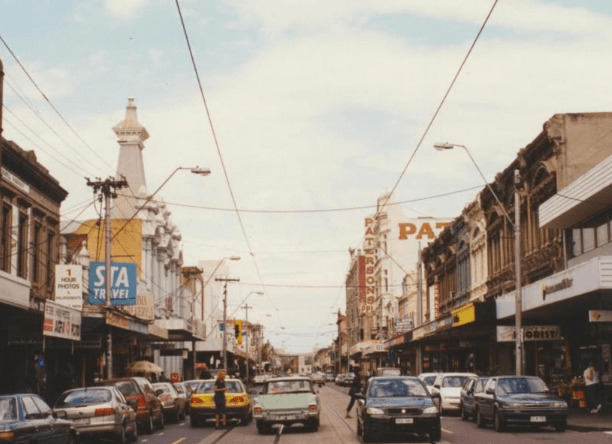
The sunlight is now beginning to shine through the blinds and Anastasia peers outside onto the street below. Her apartment sits on top of a Vietnamese restaurant and overlooks a busy street in Collingwood. Over the years she has seen the whole neighbourhood change beneath her from this vantage point, but she has also seen the many things that have remained the same. This morning, like every morning, people are slowly bringing the street the life, hopping off trams and out of their cars, in search of their morning coffees to start their day. Anastasia herself makes her way towards the kitchen to make a coffee of her own.
The apartment she walks through is a perfectly preserved time capsule, complete with wooden furnishings, yellow glass doors and worn out green carpet. Anastasia passes four bedrooms on her way to the kitchen, each filled with old stuffed toys and photos of the children who once played with them.
Anastasia’s children have grown up now and three of the four have children of their own. Only Sifi, her eldest, never had children. He was always the brightest of the family and completed university with honours, eventually getting a good job in America. Sifi has always been a source of great pride to Anastasia, but also a great source of sadness. She rarely see him and she knows that he will likely never experience the joys of parenthood. His bedroom contains the most toys, none of them will be handed down to the next generation.
In the kitchen, Anastasia scrambles an egg with spinach and feta for breakfast. She lightly seasons this with pepper, (but no salt per the doctor’s orders) and makes herself a sweet Greek coffee. She watches the coffee on the stove carefully, and takes the briki off the heat just as the coffee starts to foam. Finally she sits down, taking her breakfast to the dining table where an unread copy of the Neos Kosmos waits for her.
The paper was delivered as always, on the weekend by her youngest son Kosta. Although she is still a voracious reader, Anastasia struggles to read the newspaper these days. Whenever she opens the paper she can’t help but be drawn to the death notices and this always ruins her day. These days though even the death notices seem to be fading away, not because people aren’t dying anymore, but rather, because there are less people left to do so.
The sun has well and truly risen now and the birds have begun to sing just outside the kitchen window. Anastasia can also hear the traffic from front starting to pick up, and the restaurant owners downstairs unloading their weekly supplies. The world is getting to work, and now with breakfast done, Anastasia gets to work too.
There’s not much to do, but there’s always enough chores to pass the time, especially considering how slowly Anastasia likes to work. Her children always ask her why she takes things so slow. Wouldn’t it be better to speed through things and take as much in as possible? What Anastasia’s kids don’t understand yet though, is that speeding through things doesn’t allow you to take anything in. Even today, where there’s only really the laundry for Anastasia to work through, she will take things slowly, understanding that each garment holds a memory and a offers each of her senses a chance to flex.
Anastasia works through the first pile of clothes by folding each item carefully and lovingly. She feels the softness of the fabrics and the smoothness of the buttons. She folds each item with respect to their natural forms, so that they can lie with structure and preserve their carefully ironed creases. Some items smell stronger than others, teasing Anastasia’s memory and transporting her elsewhere, albeit briefly.
The next pile of clothing is almost entirely black. Anastasia mostly wears black these days since her husband passed away. As she works through this pile she feels as though she is dipping herself into her own grief, dismantling it one item of clothing at a time. After a while the messy pile of blackness is no more, all that remains is a bright pink laundry basket on one side of the table, and a neat pile of clothes on the other. The blackness is still there, but it has been managed, at least for today.
The final pile of laundry is colourful. Tea towels collected over a lifetime of travel, and grandchildren’s clothes left over from their occasional sleepovers. There are however a few of her own colourful clothes in this pile, invariably worn to family events at the insistence of her youngest daughter Amalia. Amalia is not fan of black clothes and especially not a fan of grief in any form, which is ironic because she created a ton of it herself.
Amalia is stubborn. She is the cause of many tense family dinners and public bilingual arguments. Anastasia spent countless nights worried over Amalia’s empty bed and many more mornings dealing with the consequences, and yet, Amalia could always make Anastasia smile, even when she didn’t want to. Sometimes that was in form of an undefeatable argument, and other times it was by insisting Anastasia wear some colour.
Amalia is the child most like Anastasia, they shares the same strong spirit. It was the same spirit that saw Anastasia disappoint her own parents many a times. She disappointed them when she refused to work in the fields, she disappointed them when she decided to go to Australia, and she disappointed them by choosing a husband for herself over an arranged marriage.
With the dry clothes now managed, Anastasia could now deal with the wet clothes that were washed overnight. She fills the pink laundry basket from the washing machine and takes it out to the back balcony. The balcony looks over a laneway and also over the neighbour’s backyards. Stavro hated this view, decrying its intrusiveness into their neighbours’ private lives. He had no interest in petty neighbourhood gossip and he used to tell off Anastasia when he caught her watching the neighbours.
It’s not that Stavro didn’t like people watching. In fact, before they were married the two of them would spend hours at the local cafes watching people pass them on the street. Stavro just has strong views on privacy and thought that the lives of others was just a distraction from what was actually important. He was always focused on the next meal and on providing for the family. That was his singular focus, and stubbornly that was what he thought should be everyone’s focus.
Anastasia on the other hand had always been a dreamer. She was curious and adventurous. This difference was what she felt made their marriage so strong. She always extended Stavro and he always kept her grounded. They were two sides of the same coin. They were both born into rural Greek farm communities, but one wanted only stay and tend to the farm produce, and the wanted to travel to the city and sell the produce.
She made it to the city in the end. A bigger city than she could have ever dreamed of. From the balcony Anastasia paused to appreciate the spectacular skyline in the near distance. Every year it creeped closer though, slowly shrouding her neighbour’s backyards in shadow.
Many of her older neighbours never got to see this happen though. What was once a vibrant neighbourhood of Greeks had changed over time. Backyards that were once wonderful fruit gardens were now where share house members recovered from their hangovers, or where affluent young families installed their pools. Worst of all, many of the old homes had been replaced by ugly matchbox apartments which brought more people to the neighbourhood but didn’t bring any sense of community.
It had been hard seeing her neighbourhood change and Anastasia often wondered if she made a mistake by staying put. Stavro and her had been tempted many years ago to move out to a big house in Doncaster, but in the end they elected to stay and now for Anastasia it seemed too late to move. It would be too hard to leave the house, the only house, that still offered her a connection to him. Every day she would find something of his hidden in the house that would bring his memory back to life. Sometimes it was a tool that he hadn’t put away or a half written note in a draw, but often it was money. Five dollar notes that Stavro nonsensically hid around the house, in books, wall cracks and between furniture. No, she couldn’t move now. She had long ago accepted that she would stay in the neighbourhood.
Anastasia stays outside for a little after hanging up the washing. She takes in the views and soaks in the sun, but eventually she heads back inside for lunch. Chicken and potatoes in tomato sauce with horta on the side, leftovers from last night. She heats up the main meal on her 40 year old stove and heats up the horta in her 4 month old microwave. She turns on the radio for company but is disappointed to hear that the local presenter is ill today and that the radio station is streaming content straight from Greece instead.
On one hand, the streamed program is presented in perfect Greek, but on the other, the sensationalist headlines being discussed are typical of any mainstream network, and doesn’t interest her at all. Another ego-fuelled war, more political corruption, a cost of living crisis. These are all things she has spent a lifetime growing tired of. The local presenter usually discusses the local community news and takes on-air calls, she has even called in one time to complain about the cafes not taking cash anymore! Not today.
The local presenters are a social lifeline most days, so when there is a disruption to the regular broadcast, Anastasia can’t help but feel disappointed, and bored, which makes the loneliness feel worse than usual. Today of all days she needed that comfort. Somewhat unusually today there have been no phone calls from friends, no doctor’s appointments for her children to take her to, and no dinner visits planned from the grandkids. In the past she would take the bus to the local café or to church, but these days her legs won’t walk her down the stairs too easily and she is mostly trapped in the upstairs apartment.
She knows though that it could be worse. She has seen how it could be worse, and she doesn’t mean death. Death can almost feel like a blessing to those suffering, she’s sure that Stavro for example is happily up there playing tavli with his mates. No, what she’s really scared of is losing her independence, like some of her friends who have fallen to dementia, or who have wound up in shoddy aged care homes. She may be trapped in the apartment with only photos for company some days, but she’s thankful that she’s independent enough to live in her own home on her own terms. That’s what she plans on doing for as long as she possibly can.
Eventually Anastasia gets sick of the radio and turns it off. She goes over to the landline to call a friend. But no one picks up. So she calls another friend. No one picks up. So she call another friend. Line busy. Bored, lonely, but not defeated, Anastasia picks herself up and gets started on the afternoon chores early. Her daughter Zoe will be coming over for dinner tomorrow with her family and Anastasia has been preparing something special.
She cleans the kitchen benches and fetches two large mixing bowls from the fridge. One contains dough, resting since yesterday, the other is full of washed leafy greens which are ready to be worked with. She roughly chops up the greens which are a combination of spinach, silver beet, parsley and spring onion. She adds them back into the mixing bowl along with feta, ricotta, olive oil and an egg to bind it all together. She mixes this all by hand and completes the mixture with salt, pepper and oregano. She sets the green and gold mixture aside and now begins working with the dough.
Anastasia expertly rolls out the dough on the table and evenly distributes scoops of the green and gold filling across it. She cuts circles into the dough around each scoop and proceeds to create delicate little dumplings, kalitsounia. It’s a tricky process done by hand, requiring focus to make sure nothing sticks or slips where it shouldn’t. She lines up the uncooked kalitsounia on trays and places them back into the fridge, ready to be fried fresh tomorrow. She can’t wait to see her visitors drool over the kalitsounia at tomorrow’s dinner. They will be served fresh and hot, dripping with oil and exploding with flavour.
By the time she finishes the midafternoon school traffic has brought a new life to the street outside. In years gone by this was Anastasia’s favourite time of the day. Stavro would come home with the grandkids after primary school, and she would spend the rest of the afternoon preparing a family dinner as the kids watched their cartoons. Stavro would head straight to bed for his daily siesta and arise only when dinner was ready. This is the memory Anastasia carries with her as she trudges back to bed. Today though there’s no family dinner to prepare, and no husband snoring in the bedroom. His side of the bed has been empty for many years now and the best Anastasia can hope for is for him to return to her in an afternoon dream.
Try as she might though, Anastasia doesn’t dream, she can’t even fall asleep. She’s never been one for the afternoon siesta but she has gotten used to lying down in the afternoons anyway. What else is there to do? At least this way she can provide some respite to her sore knees and her crooked back after a full day of chores.
As she lies in her bed, awake, she stares at the ceiling and tries to remember what his snoring sounded like. She ties to remember how the mattress used to sink beneath them, and how it would nudge them just a little closer together. She can almost again feel the warmth of his body. But she can’t. Next to her is just an empty space. She turns on the bedside radio. It’s playing classic rebetika this afternoon, slow sad music that drowns out the silence of the room. But the music can’t dry the tears that gently trickle across Anastasia’s face.
As the sunlight outside begins to dim, Anastasia rises out of bed once again and heads to the kitchen to prepare dinner. In the kitchen she draws a large meat cleaver and hacks through chunks of pork. She finely dices onions and carrots while she heats a pot on the stove. She fries up the mirepoix and the apartment soon bathes in aromatics as the onions caramelise. The pot sizzles violently when Anastasia adds the rest of the ingredients to her stew. Stock, wine, meat and potatoes. The concoction bubbles and transforms at her will, wafting out of the kitchen window with a tempting aroma that stops passersby on the street. She may be the last Greek woman in the neighbourhood but as long as there is at least one left, the neighbourhood will continue to under the same spell each dinner time.
It’s a meal that she will enjoy today, and also tomorrow with the family, but Anastasia doesn’t mind doubling up in any case the Doctors would say its good for her to eat more meat for her iron levels. Once the cooking is done, she eats her dinner, cleans the dishes, and then she sits to reflect on her day.
The street is outside is quiet once again but she knows it will be full of life again tomorrow. For now, there’s nothing left for her to do, but prepare for sleep. She has a shower, makes herself a mountain tea and drinks it while she listens to the radio. She did not speak a single word today.
Finally Anastasia makes her way to bed and lies down. She stares at the ceiling in silence and waits. Not for sleep to arrive, because you can never know when sleep will arrive. Sleep will come, without fail.
She stares at the ceiling in silence and waits. She waits to wake up again.


Leave a Reply