
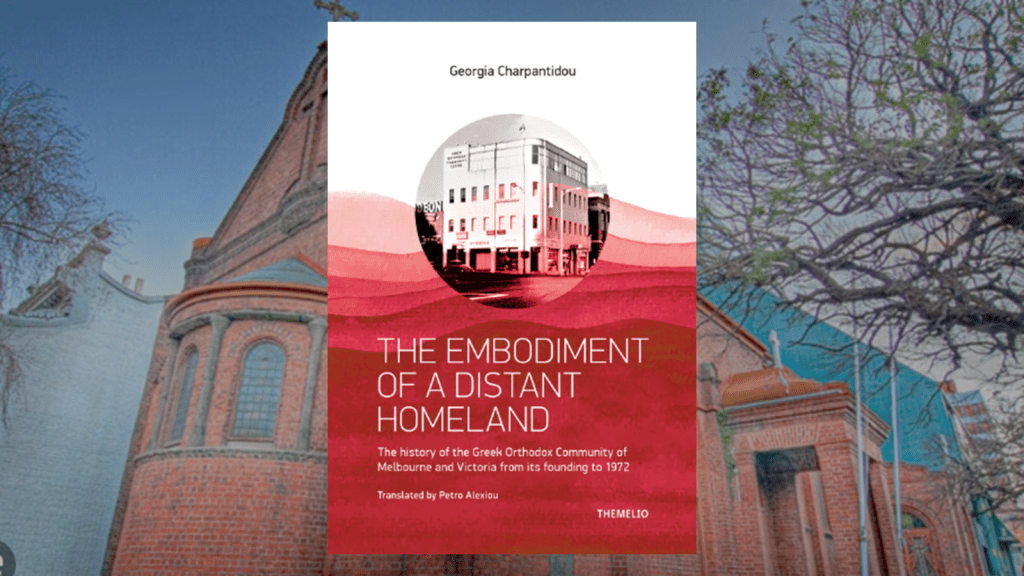
I first heard of this book after seeing an article in the Neos Kosmos. Just months later I found a copy in the Paperback Bookshop and was told that I purchased it on the first day after its delivery. Turns out that they had such a good reception with Nikos Papastergiadis’ book that they decided to stock this as well.
I thought this book was excellent. It was clear and concise, documenting the history of Melbourne’s Greek community chronologically until the early 1970s – which was understandable as any date beyond that point would probably ruffle a few feathers of people involved in today’s community. I read a translation, and as the book was originally meant for a Greek audience it makes sense that the early chapters cover the establishment of the Australian colonies before expanding on the Greek Community’s story.
The Greek Community’s story though was not one that developed in isolation. Along the Community’s development, key events and political happenings on the other side of the world fuelled growth, conflict and development of things here in Melbourne. I learnt that the early communities in Australia came as a result of the Gold rush in Victoria, primarily with roots from trade islands like Ithaca. This continued for decades and seeded the establishment of the Community which was a joint venture with Syrian orthodox migrants with the sole aim of establishing an Orthodox church. That church was Evagelsmos but the subsequent decisions would fuel conflict for decades. The decision of the community was to align the Church to the Church of Greece rather than the Ecumenical Patriarch, party to align themselves with the free Greek state and the liberation cause, but also due to the view that the Patriarch was compromised by Ottoman influence. This early community had bought into the idea of a Free Greece, its ethno-religious identity and the broader irredentist cause.
The Community was funded by wealthy migrants and supported new migrants in many ways. It was interesting hearing how Greeks were wrongly targeted during world war hate as Anglo Australians would confuse them for Italians! It was also interesting how volunteerism and issues with paying the priest dominated the drama of the community’s early years. Later as the world moved on from the world wars a new fear emerged, of communism. The Community was not spared this divide and the next chapter of its development saw it wrangle with the ideological split and minimising the influence of communist members.
Of course with the changing of Australia’s migrant policy the Community grew greatly post the world wars and with this growth saw the increasing influence of the Church. Soon the Community’s battle was not with Communists in its ranks, but rather with the Church and ensuring the Community maintained control of its assets and remained the leading body of Hellenism in Melbourne. Unfortunately the Community was no match for the Church’s decentralised approach to community development as well as its regular access to members through regular services. Even today this balance is present, where the Church dominates Melbourne’s Greek Community in terms of footprint and active membership, however the Greek Community of Melbourne manages secular cultural programs far better, notably the Greek Film Festival and Antipodes Festival.
This book gave me great context to migration patterns, community conflict and the roots of the Community. Once I got started I couldn’t put it down!
 ehhere
Leave a comment