
I was walking along Sydney Road with a bit of time to kill. I had a pie, walked through Princess Park and browsed through a Socialist Bookstore. The store is pretty new, and initially I was curious why it had been set up at all. Inside everything was political, the staff appeared to be young socialist alliance members from nearby unis and later I found out that this was actually the brick and mortar store of Red Flag books, a socialist publisher.
I’m curious about these kind of subcultures, and I guess the location of a place like this makes sense. Brunswick has a long history in union and labour movements and the current demographics of the area have exploded with young students at the universities. As apartments have come up and Carlton has priced out many students, increasingly more and more young energy and artist energy is finding itself north of Brunswick Road. There is a broader trend here, with even suburbs as far as Reservoir picking up an increasingly hipster crowd but I digress – the areas are becoming less ethnic, and in Brunswick’s case increasingly more politically active than it has been the last 20 years.
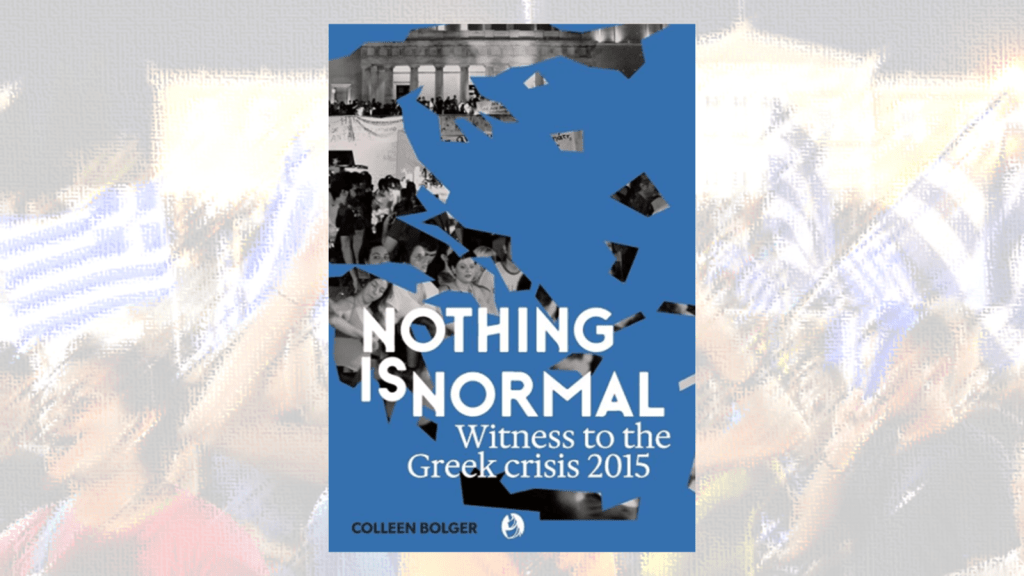
The bookstore itself was pretty bare, a lounge space at the back, shelves of socialist perspectives on everything from local politics to international events. Propaganda posters, leaflets, you get the idea. Nothing jumped at me as I browsed the shelves, until I stumbled on Nothing is Normal. The book was a collection of articles written by Australian journalist, Colleen Bolger, while she was in Athens during the time of the 2015 referendum. I was also in Greece at the time, but curious to revisit the era from someone older and I was hoping more informed than I was.
I remember on the islands that the referendum dominate the news cycle, but I was a young Aussie on holiday with my family. Where we were the crisis hadn’t hit as hard as it had in Athens so although the ‘Οχι sentiment was strong, I was protected from understanding the real impact of the crisis. These stories of hunger and poverty were mostly just stories, between the beach and coffee. Obviously there was more pain and care than just that, but it’s just to say that I was privileged in my own position, I didn’t feel the pain of the locals.
Alongside Bolger’s articles is photography from Tia Kasambalis and an interview with Panos Petrou. There is a lot of photography accompanying the large text articles to beef this ‘book’ to about 200 pages, but the photography captures the energy, protest, jubilation and pain of the referendum time that I remember, it also showed the urban movements that although I am familiar with, I was not present for in 2015. In the photography I recognise a lot of modern Greece. The faces, the laughter, the smoking, the dancing, the anger. It was a great way to fill out this book and made Bolger’s outside perspective feel a little more grounded.
Ultimately Bolger’s perspective is that of an outsider. The articles themselves are well written but the narrative is skewed by her socialist and non-Greek lens. I mean, this isn’t surprising and it was fun to read such a different perspective. The early descriptions of media bias ahead of the referendum was fascinating and confirmed by the ultimate result (61% ‘Οχι) but the later articles tracking Syriza’s capitulation are intertwined with opinion about alternatives and later, opinion about the party’s reconstruction. These later articles feel less present, not just in their forward looking calls to action, but also in their struggle to untangle the mess of a Greek radical coalition party – although fair play, seemed to do a pretty good job with exceptionally tough material.
The last part of the book discussed what has happened to Greece since. As all over the western world, it has experienced growth, increases in inequality and increases in precarious work. Overall I think the book highlighted the hopelessness of the referendum time. Greece and Europe for different reasons were shitting themselves, and there felt like there was a real threat of things blowing up. In some ways it did.
 ehhere
Leave a comment