
After reading Zorba – twice, because for some reason I thought I would process more from doing so – I decided to read another Nikos Kazantzakis book. For one, the author fascinates me. He story of excommunication, Nobel nominations, travels and literary standing is fodder enough, but the fact that he is also Cretan really makes me want to understand him a little more. Secondly, I enjoyed Zorba, it was philosophical and fun and I genuinely reckon there’s a good Netflix mini-series in it for someone more connected than me who shared the same foresight, and frankly, courage.
I missed out on a chance to purchase some Kazantzakis books in Greece, I was already reading too much, so when I got back to Australia I was upset to realise how hard they are to find. Eventually I found this copy of Report to Greco in Dymocks in the city. I find it frustrating that one of Greece’s most celebrated modern writers has such little sway in western literary imagination, but I guess other nationalities suffer the same experience with their writers. It’s also somewhat frustrating that I can think of only few Greek writers. I’m not sure if that says anything about their writing scene, it’s sway internationally or dominance of others. I wonder if AI will change things, certainly in terms of volume (shit ebooks on amazon) but in terms of translation?
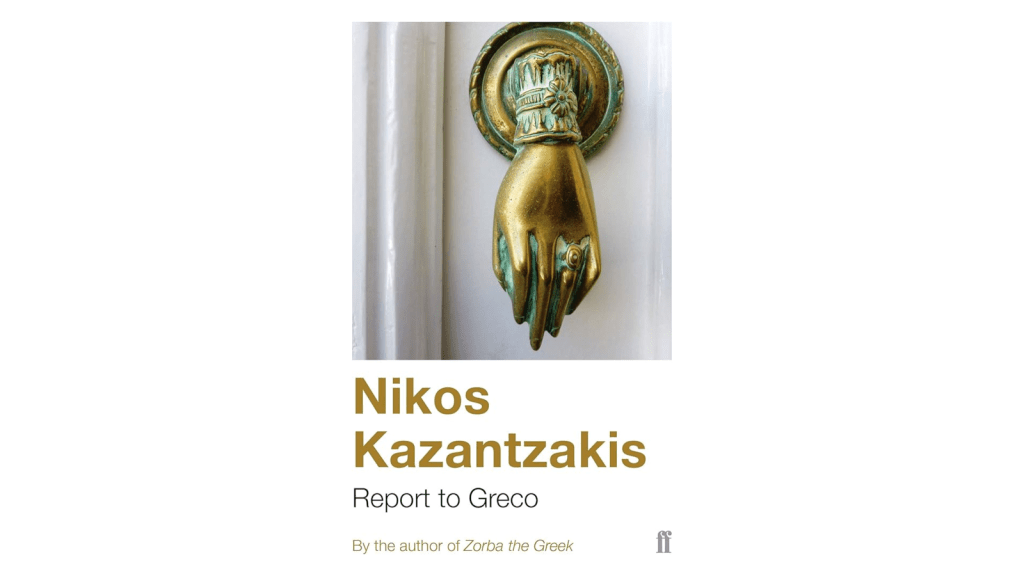
Anyway, I bought it and I read it. Report to Greco is a semi-autobiographical book. It follows Kazantzakis’ life chronologically with a focus on his spiritual journey. The early chapters told of life in Crete and his connection with family. It was fascinating reading how patriotic they were and better understanding life under Ottoman rule. There was a constant sense of duty and revolt. Kazantzakis is what I would describe as a good Greek boy. He was religious, shared his family duty to each other and to Crete and saw the world through this lens. It seems he was really lucky to have parents who supported him in his academic pursuits, who helped him follow his own curiosities rather than push him to live a certain way. There certainly was a lot of that, but his larger than life father seemed to understand Kazantzakis as an intellectual offered more to the Greek cause than Kazantzakis as a foot soldier.
The stories of his adolescence followed the family escaping danger by living Naxos, where Kazantzakis was nearly kidnapped by the Catholic church, and continued to follow his early taste of adulthood and early romances. Thankfully Kazantzakis was intent on seeing the world. His gap year of sorts was strange by today’s standards and also by historical standards. Rather than pursue other young people Kazantzakis travelled through Athos and the Middle East searching for spiritual guidance. This obviously shaped his view on travel and when he returned to Crete rather than continue his studies in Athens he received permission from his father to study in Paris. There he was similarly anti-social, studying to the point of being told off by neighbours. Kazantzakis in some ways let his Youth slip away in pursuit of the eternal. He wanted to be a saint, so he didn’t live as a human.
I think it’s amazing how he managed to expose himself to so many different view points and yet remain so committed to his faith. Nietzsche, Buddha and Lenin came to dominate his thoughts but always through the lens of Christ. Kazantzakis seemed to be searching for the universal truths of life, and found commonalities across these figures.
The second half of the book took us on an incredible journey, from Paris to Russia to saving the Greek minorities from the genocide in the Caucuses. We hear about the real life Zorba and in all of this I recognised how many real life experiences Kazantzakis actually used in his novel on Zorba. As well as the stories themselves Kazantzakis signature writing style (noting the translation of both) shines through. Each passage felt philosophical, each moment had some sort of hidden message and he would tend to describe situations as though they were happening just for him, as though he was the only person in the world and the world was just a message from God. At times it was beautiful, but across 500 pages – and yes I perhaps should have broken up my reading of this a bit – it also felt a little exhausting.
Kazantzakis was undoubtedly a great man, a deep thinker and philosophical about how to live his life, but despite what he writes, I felt like he spent so much time in his own head.
 ehhere
Leave a comment