
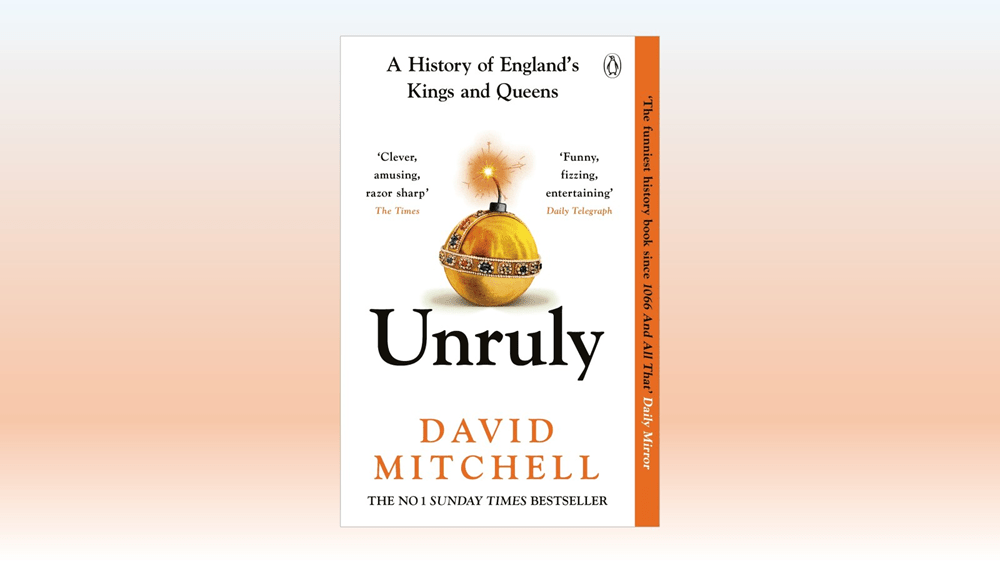
I’ve always enjoyed David Mitchell’s work and comedic tone. I’ve watched him on Peep Show, That Mitchell and Webb Look and of course on Would I Lie to You. Over the course of about 15 years and across these very different works, one thing has struck me about him which I can’t say about too many people, I find him funny – and mostly in a way that he would approve of too!
Although I have in the past read a collection of Mitchell’s works for The Guardian, Unruly was the first ‘real’ book of his that I had read. One of the reasons I picked it up was to explore Mitchell’s passion for history, a passion which I had only seen glimpses of in his other media appearances. In his television appearances Mitchell has always weaved in smart critiques on history (notably his famous ‘Are we the bad guys’ skit and Peep Show’s iconic ‘Business Secrets of the Pharos’ story arc) but these always seems to end with his characters presented as history tragics. My hope for Unruly was that it would allow Mitchell to explore his passion for history unapologetically, and to my delight, it did.
In his life before comedy, Mitchell was Cambridge educated historian and Unruly put his education to use as a digestible pop-history book which examined the English monarchy. Unlike other pop-history books I have read (namely, the Shortest History of France, by Jeremy Black), Unruly never felt like it was going through the motions or simply ticking all the boxes. Although Mitchell similarly presents a simplified linear history, his writing is prone to humorous asides and detailed elaborations of historically inconsequential facts he seems to simply finds interesting (including Viking’s lack of horn helmets). Even in when presenting the linear history though, Mitchell weaves in cultural critiques and topical comparisons which helped make the stale facts feel more relevant for today, and he would often build on these by discussing his thoughts on today’s social classes and English identity. These wrinkles and divergences from the straight history helped make Unruly feel less like a Wikipedia article and more like something worth reading.
I read this for enjoyment rather than to begin a career as a historian. In fact, I came into the book with almost no knowledge of the crown at all and I finished it without the ability to list the English Kings and Queens sequentially – I still don’t even understand the full importance of 1066! However what this book did deliver for me was enjoyment and a broader sense of English history. I was left fascinated by the impacts of the Roman Empire in Britan, the French-ness and Viking-ness of the Kingdom and above all, the importance of the illusion of power.
If I wanted to memorise a list of kings, YouTube is probably the best way for me to learn, but Unruly was an enjoyable and worthy read that made me laugh and made me curious. Mitchell’s exploration of Kings and Queens was a delight and offered a very valuable insight into the nature of humans and broader power structures we still have in place today.
 ehhere
Leave a comment