
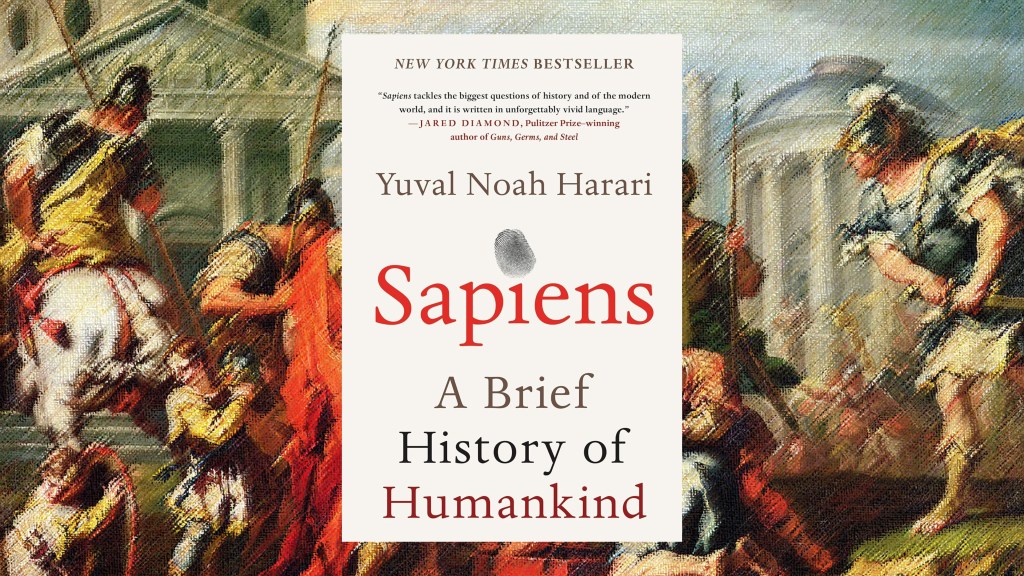
Sapiens endeavored to tell the story of us, from a starting point much further back than we may be used to. This anthropological deep dive into the development of human culture and society was a fascinating and enjoyable read. For a story so large I was delighted by the clear writing style and simple structure which broke up the book into four chronological parts.
Starting with the ‘Cognitive Revolution’, Harari describes human pre-history and introduces some pretty wild concepts. Not only are Homo-sapiens presented amongst other subsets of the species but Harari presents a rapid pattern of extinction that accompanies human migration. I found this section to be the most enjoyable, not just for its novelty but also as it seemed to be the most objective section in the book. Everything here is served with a large pinch of salt with speculation and alternative theories clearly identified and presented as such.
The ‘Agricultural Revolution’ described a revolutionary change in human culture. Surprisingly, Harari describes the onset of early farming in almost dystopian terms explaining how it led to malnutrition, concentrated community risk and monotonised peoples’ lives. An interesting observation here is the immediate loss of foraging knowledge which were lost to agricultural practices. This potentially occurred after just a few generations, meaning humans didn’t even have the option to return to the old ways! This helped me reflect on current generational losses, particularly ethnic traditional and language losses of modern migrants – but also made me ponder what we have lost without even realising. We don’t know how the pyramids were built, and my kids certainly won’t know how to use a VCR.
In the ‘Unification of Human Kind’ Harari explains how trade helped break down cultural barriers and how empires homogenised cultures. From this point, the book started to morph not just into modern history but lacked the self-critical lens that was so present earlier. Although I largely agreed with Harari’s conclusions, it’s clear that his own personal views were present in this section especially in his descriptions of Buddhism and meat eating practices. This section though still told an enjoyable story about the development of religion and the sheer randomness of the dominance of particular cultures. In particular I was really interested in the discussion of historical polytheism and the prevalence of similar practices in seemingly monotheistic religions. Harari explains this with a fascinating take on human’s ability to justify their own contradictions. He also uses explains this may be an important feature in the development of culture.
Beyond the development of cultural practices, Harari also explores the proliferation and conflict of cultures through exploration of empires and eventually commerce, contending that money is the most powerful, and may be the final, unifying force of humanity. It was sobering to read of this increasingly homogenised culture which Harari presents, and worse still to note the gravitation of people towards a force as cold and soulless as money. The intersection of commerce, empires and colonisation is a crazy example of this – with one example even presenting the success of the Greek revolution to have been partly the result of British business interests. However Harari peppers these conversation with philosophical musings, exploring common features across religions which provide a sense of hope and common good.
In the Scientific Revolution, Harari tells of the emergence of the scientific method and with it, the pursuit of immortality. Although this section probably stuck with me the least it did show the accelerating and terrifying progress that humans are making. Here, Harari also points out many modern challenges we face, emphasising the Climate Crisis and in some ways the inability we have as individuals to stop these monstrous forces.
Overall though, I enjoyed this book. It was well written and provided some fascinating perspectives on Humanity. I finished it with many new interests, among them a curiosity about the Roman empire, the importance of the direction of science, and concern for the crisis of financial imperialism.
 ehhere
Leave a comment