
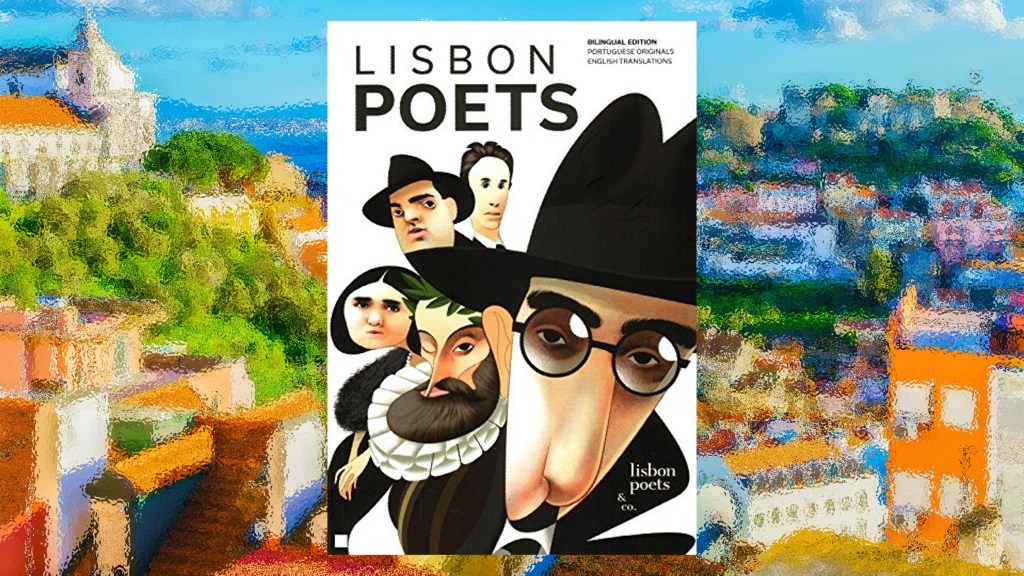
You can probably last about a day in Lisbon without hearing about Pessoa, fortunately for me I was in the city for longer than that and has the opportunity to learn more about the great man. Statues, tour guides, street signs and souvenir shops preach his greatness so when I was given the opportunity to purchase some of his poetry in English I jumped at the chance.
Lisbon Poets though didn’t just present Pessoa’s works, but also a collection of poems from four other great Lisbon writers. The book was a great way to sample the city’s literary journey and also provided an insight into the development of the Portuguese psyche.
The book was excellently compiled featuring an insightful forward piece followed by a section for each poet. Each section included a brief introduction about the poet’s life, which helped to contextualise and interpret the proceeding selection of works. Each poem was presented in Portuguese and English, which helped me whiz through the book as I only had to read the English half! This however did obviously change the poetry, as the translations missed rhymes and undoubtedly would have lost some of the precision and wordplay. With that in mind, I read typically for themes and insights into the writer’s experiences and perspectives, with aesthetics only forming a rarer and smaller part of the content.
The early poetry from Luis de Camoes (a 16th century explorer) and Cesario Verde (a discontent 19th century writer) kicked off the book. Although the writers experienced very different lives and perspectives, I found that both of their works employed more conventional forms which was easier to connect with. In terms of subject matter things could not have been more different but the description of Camoes’ international travels were equally as illuminating as Verde’s descriptions of city life. Funnily enough the top poems I selected from both of them were about love, and insightfully described its power. I found both of their works presented writers with a curiosity with the world around them as well a deep passion.
Mario de Sa-Carneio’s works followed, and perhaps I was influenced by his introduction as a sad rich person but I didn’t connect with his poetry the same way. Generally I felt there was too much self-pity and sadness, as well as a lack of insight into the world except for his own deteriorating inner world.
Florbel Espanca on the other hand flipped my impressions on their head. She was the only female poet in the book and presented as one that the publishers had the ‘pleasure to introduce to us’. Embarrassingly I thought she represented a token feature in this book but was surprised by her unique voice and beautiful poetry which retained aesthetic even in English. She was my favourite poet in this book not just because here poems remained aesthetic but also because I felt a genuine sensitivity in her words. There was a humbleness in her writing which lacked from the other writers in the book. Rather than state things as the where she was almost asking questions and leaving themes open ended, expressing herself authentically in regard to love, the role of writing and insecurity.
The book closed with the main act, namely Pessoa. Pessoa famously wrote under many heteronyms. Only later was it discovered that hundreds of works previously thought to be other writers were actually all written by the one man. His works were presented under their published heteronyms and interestingly you could see both the similarities across all the works, but also the unique characters behind each name. I didn’t like the work that devolved into nihilism however found a lot of Pessoa’s work to be worth the read. He ponder on universal connection and meaning in a way the others didn’t, offering guidance to living in an uncertain world and an awe for the mysteries of the universe.
Overall this was a great collection of poetry and a great way to sample the city’s best historical writers. I’m still getting my head around interpreting and connecting with different poets but I think historical writers like these utilise more conventional styles and themes which are easier to connect to and enjoy.
 ehhere
Leave a comment