
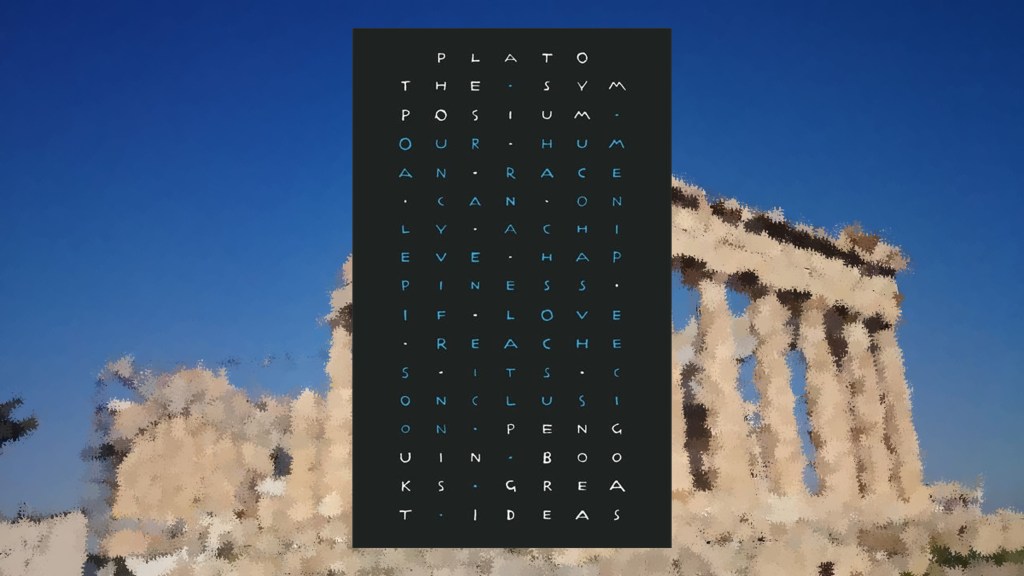
Well this was a weird one to say the least. I hadn’t really had any exposure to classical literature and picked this book up with that in mind. I found it at a bookstore, noticed it was short and included a second piece on the Allegory of the Cave, which I had at least heard of before. I figured it was a low effort entry into the classics, and pretty cheap too, so why not?
Well I’ll tell you why not. It’s over 2,000 years old, probably been bastardised by a few too many translation and made squirm almost from the start. The Symposium for those who don’t know, is apparently a loose recount of a post dinner conversation of famous Athenian philosophers.
So it turns out, that back in the day, apparently this governing class of philosophers would have dinner and they unwind with a structured conversation over a few drinks. A romantic vision of this would make most academics quite excited. Indeed, to be able present evidence of such civility from so long ago, with a collection of some of history’s best known names suggests The Symposium would have to be a must have for any complete book collection. Well hold it right there. 2,000 years is a long time, and a text of such age brings to mind the lessons of Mark Corrigan’s famous work, Business Secrets of the Pharaohs.
“The first thing to note when discussing the business secrets of the Pharaohs is an acknowledgement that their era was so completely different from our own that almost all cultural, political and particularly business parallels we draw between the two eras are, by their very nature, bound to be wrong”
The Symposium presents a conversation about the god of love. Each philosopher got a chance to get up and discuss their ideas of love. Ideas I should add were often presented in morally reprehensible ways by todays standards. Sexism, for one, is ever present, not just in the lack of presence of female speakers but also in how women are generally spoken about in this book. In some ways this divergence from today’s moral code was refreshing, it was fascinating to me just to see how different other societies could be. In this way, this book was a shock to the system. It painted a world completely foreign to my own. Even the small talk around the main content outlined conduct and practices beyond modern comprehension including perceptions of slavery and class.
It was cool to see statesmen discuss the philosophy of power and purpose as it intersected their roles and wider society, and I hope that current statesmen are able to question their own morals and guide themselves towards something resembling a greater good as well. On the flip side, the discussions around anything even remotely scientific were so outrageously incorrect I simply had to read in disbelief. I was almost in awe of the freedom of discussion, which ignored anything resembling scientific thought and replaced it with poetic myths as fact instead. I felt the conversations led to some nonsensical outcomes where opinion was presented as fact, and metaphors were presented as actuality.
It took a little while to adjust to this world and the style of the book, but once I did it was interesting to unveil some unique philosophical concepts I hadn’t thought of before. The different types of love (έρως, αγάπη etc), the search of love to make one whole, the nature of love as a relationship to things rather that a thing in and of itself. If nothing else it was open conversation free of judgement, but also free of scientific truth and in a world of very different moral and cultural standards to our own.
I thought The Symposium would be a good introduction to the classics owing to its size. In hindsight I should have chosen something with a more digestible subject matter.
 ehhere
Leave a comment