
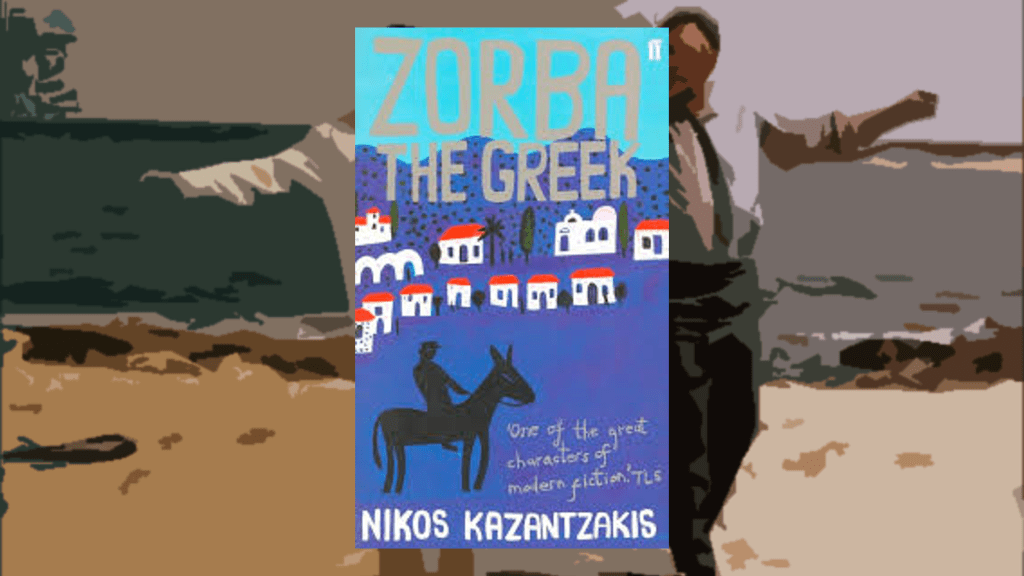
I already know this review will not reflect the many feelings I have about this book. Zorba the Greek stands alone in the western consciousness as the embodiment of Greek literature. A book elevated by its Oscar winning film adaption and Nobel Prize nominated author. A book, I believe, is not correctly understood or interpreted in the modern day.
I was shocked reading Zorba. It was violent, vulgar, and of another time – more so than I expected. Having not even seen the film, the only image I had of the story was of Anthony Quinn dancing on the beach. I was expecting to read the story of a lovable larrikin who would reveal the ultimate ways to live life, and I was wrong. What I received instead was a complex, conflicted presentation of two flawed characters, engaging in a never ending conversation which yielded no clear answer.
Ironically the setup of the narrative is quite simple. A young wealthy bookworm (the un-named protagonist) partners with an older boisterous merchant (Zorba) to embark on a mining project in Crete. The two settle in a sea side village encountering the locals, struggling to make their venture work and discussing life along the way.
The writing itself if a challenging item to unbundle. I read an older translation rather than the more recent Peter Bien translation. The older translation has been criticised for lacking the nuance of Kazantzakis’ original work as well as taking some items out of context. Has this contributed to some of the stereotypes used in the book? The harsh language? Revised context of Hellenic identity and history? I can’t say, all I know is the writing feels of its time, with an older more mechanical English.
Although the book broadly tracks the mining venture, the real story is the protagonist’s developing sense of meaning. As the two main characters are confronted by the harshness of village life they discuss and confront different philosophical quandaries. The dynamic is enhanced by the protagonist’s authentic curiosity and literary research (particularly Buddhist philosophy) as well as Zorba’s life experience and seemingly decisive perspectives.
Regarding the narratives though, I have to say it would work well not as a movie, but as a TV series. The philosophical development of the characters occurs in discrete scenes and episodes. We see the main characters encounter the harshness of village life, and the harsh people it creates. They encounter the duplicitous nature of monks and ponder the intersection of religion and real life. The widow and their French hostess challenge their notions of romance whilst the protagonist’s travelling friend challenges their notions of war and nationalism.
The book’s main construct works well and the plots are enthralling. The writing and even philosophical conclusions are certainly challenging for a modern mentality however Zorba the book is still undoubtedly a worthy read, even if it shatters the happy image of the man himself dancing on the beach.
 ehhere
Leave a comment