
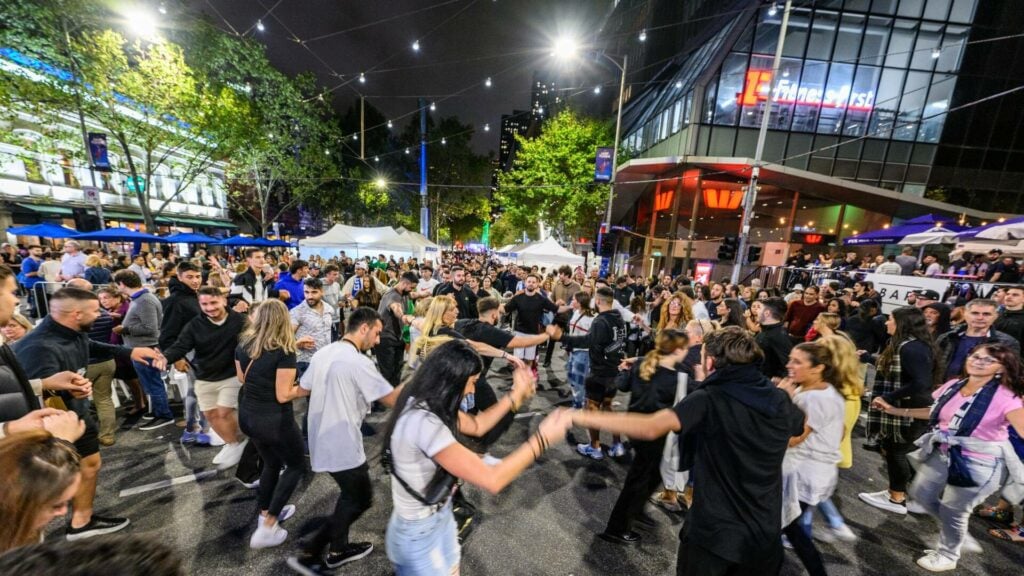
Melbourne has experienced a noticeable change in its Greek music scene as of late. Rebetiko, Greek Rock and Greek Jazz events have been popping up faster than I can keep track of. This year many of these acts were featuring at Antipodes across its three stages. However, as I lacked the ability to be in more than one place at a time, this this year I was faced with a choice… I either had to miss out on the best acts, or actually plan out my weekend on Lonsdale Street. So for the first time ever, I denied myself the great joy of randomly meandering through the festival and studied the event program instead.
As I read through the program though, my mind began filling with questions… Is most of this festival Pontian? Are all the dance groups from the same area? Are there really no acts from Oakleigh? Many of these questions remained unanswered after attending the festival, but rather than let my mind be impacted by my own biased experience, I decided to do something (a little) more scientific. I studied the stage acts festival program and analysed their key characteristics. What emerged was a series of patterns that revealed the strengths, gaps and potential opportunities for the Antipodes Festival.
What was on stage?
58% of the performances on stage were Music Acts while 21% were Dance Acts. This was supported by the fact that music acts are typically longer (average time of 59 minutes) compared to dance acts (average time of 31 minutes), as well as the fact that multiple Music Acts were able to be supported by the same pool of musicians. The most noticeable example of this trend was across the five Rebetika acts, which featured many of the same musicians.
Interestingly though, Dance Acts were actually given more prominent slots and actually accounted for 50% of programmed time on the Main Stage. Music only featured 25% of the time on the Main Stage. Dance Acts were also most prominent on Sunday where they accounted for 29% of total program time, whereas on Saturday they only accounted for 14% of program time. The numbers support the anecdotal Antipodes sentiment, that Saturday is a party day and Sunday is the community day.
Community Groups are important for Diversity and Growth
Community groups continue to play a major part in the festival, accounting for 88% of the programmed Dance Acts. These community dance groups also played an important part in the regional diversity of the festival, for example, they were the only instance of Kalymnian culture programmed. The list of Community Dance Groups though also demonstrates the most visible consolidation of Melbourne’s Greek cultural tapestry. Not listed were the formally represented Cypriot Community Dance Group, Pan-Macedonian Dance Group, nor the Pallaconian Brotherhood Dance Group of years past.
Analysis of the Community Groups present at the festival also reveals a surprising statistic. All Community Groups participating on stage were located in either the Northern Suburbs or the Eastern Suburbs. Despite Oakleigh holding the title of the Greek heart of Melbourne I could not find a single Community Group on stage representing the area – there was not even an Oakleigh Grammar Stall present at this year’s festival. The real shining community of Antipodes is the Greek Community of the Northern Suburbs, who’s community groups accounted almost 6 times as much performance time as the Community Groups of the Eastern Suburbs. It appears the Antipodes organising committee has a big opportunity to grow the festival if it is able to engage the Greeks south of the Yarra.
Diverse Musical Traditions on Display
There was truly music for everyone on the Antipodes stages this year. Only about 21% of the music played this year was either Laika or Etekhna, whilst a similar amount of 18% was actually Contemporary Greek music comprising everything from Rock to Swing. The emergence of bands like Heirs of Apollo and the Cats and the Canary has been well documented but it appears this year’s Antipodes saw new contemporary bands join them too.
11% of the music on stage was Rebetiko, a massive growth on recent years, and largely a result of the huge efforts of Con Kalamaras and his contemporaries, specifically in their ability to incubate and foster new talent through programs like their Rebetiko Jams. The largest portion of music at the Festival though, as always, was Folk and village music. 19% came from bands covering a broad spectrum of folk music, and another 20% came from region specific bands representing Crete, Pontus, Epirus and Macedonia.
Are there really Cretans and Pontian everywhere?
In short, yes. Both the Cretan and Pontian communities once again outperformed their relative community sizes with huge volunteer efforts. They both represent the two largest regional specific components of the festival. Cretan entertainment accounted for 11% of the festival program, supported by the united efforts of the Cretan Brotherhood and Pancretan Association as well as local bands Delyrium and the Vardakis Parea. About half of all Cretan Entertainment though was attributable to two sets played by the Xylourides feature act. Pontian entertainment accounted for 9% of the festival program, supported by a number of dance groups including the Pontian Estia and the Momogeroi program.
What Cretan and Pontian communities have in common is the distinctiveness of their regional cultures as well as a larger community population. This means their members can benefit from both a unique cultural experience and an immersive community experience. Mainland Greek folk tradition on the other hand appears to be preserved in the generalised folk dance groups such as that of the Greek Community of Melbourne. Island folk tradition on the other hand appears to struggle with attracting significant numbers to form groups, with the exception of the Kalymnians. One personal concern though is the lack of Cypriot tradition on stage this year. It is hoped this can be increased next Antipodes considering the recent existence of multiple Cypriot dance groups in Melbourne.
The Church
For many though the main pillar of their Greek Community experience is not music or dance, it is of course the Church. On this point, one would not expect a liturgy on stage but considering the odd relationship between the Greek Community of Melbourne and the Archdiocese I couldn’t help but look into the Archdiocese involvement in the Antipodes festival. I think the Church missed out on a huge opportunity to have a stall and showcase their programs (including the Byzantine choir), and they certainly should have had a stall for their Greek School program Aetolian College – but they were indirectly present in many other ways. They are supporters of the Hellenic School of Dance, Culture, Arts and Music. They also are the backers of St Johns College who were present in stalls and on stage. We may not have seen the Archbishop there, but the Church’s presence was felt at Antipodes, albeit indirectly.
Not perfect
My analysis was quick and dirty, and should be read with a grain of salt. Data entry errors may be possible both on my end and due to the Antipodes online program. Factors like stage preparation times are not considered. Assumptions include roving performance times and some characteristics of the acts based on online facts available in my quick research. However it doesn’t take away from the fact that assessing the program revealed a number interesting points, including the richness of the festival’s diversity.
This year’s Antipodes also presented Una Fazza Una Razza (a Greek-Italian collaboration), Totally Kicking Brass (showcasing sounds from Northern Greece), School Choirs, Theatre and more! Even if Antipodes isn’t a total reflection of Melbourne’s Greek community, it certainly showcases its diversity and vibrancy. It’s ultimately an amazing festival we should treasure, contribute to, and protect – long may it continue!
 ehhere
Leave a comment