
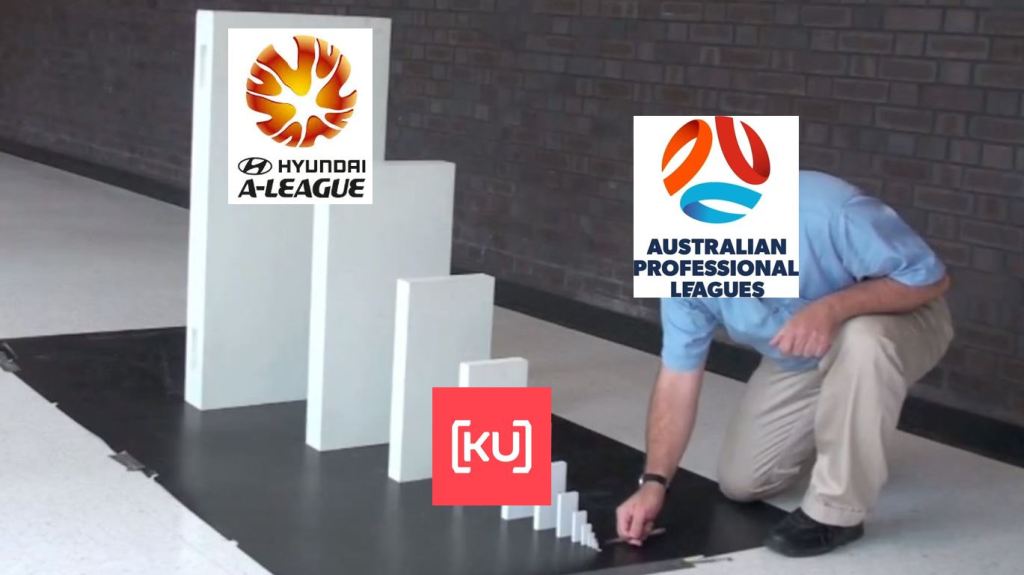
This week saw some bad news hit the A-League after the Australian Professional Leagues (APL) announced that half of its workforce would lose their jobs, and that its media platform KeepUp would be cut. Cue negatively.
Mainstream media published negative stories, Bosnich & Slater criticised the APL on radio, and online both old soccer & new football fans loudly predicted the end of days. In response, the MAFFS podcast called out this negativity and pondered the reasons for the football community’s endless existential crisis. In doing so they touched on a more important issue than the jobs that were lost, they touched on a notable trait of Australia’s football community.
There seems to be an endless conversation about the game’s viability and its place in Australian society. This is a serious problem. It’s exhausting. It’s a conversation that is highly emotional and minimally constructive and it has been happening for as long as I can remember. But why is this the case? Well, when I turn back to my own internal narrative of the game here, it starts to make sense why the football community often acts as it does.
A historically inaccurate social timeline
- 1800s-1940s – Nothing really happened here. The game is played in local tournaments by Englishmen and a handful of other migrants not integrated into society.
- 1950s-1970s – The Wogs come and set up clubs. Racism intertwines with football as the mainstream antagonises the migrants via the game. Local councils prevent use of grounds, vandals scatter glass on the soccer pitches, and to soccer’s detriment, established sports protect their own interests through the media and politics.
- 1970s-1990s – The NSL years. The game is semi-professional and run mostly by volunteers. Racism continues in the form of ignorance, media narratives of ethnic violence both real and imagined.
- 2000s – NSL dies. Old Soccer is out, and New Football is in. Scorch the earth, clubs, youth programs, systems and people.
- 2005 – 2010 – This entire time people are either celebrating the NSL Socceroos in World Cups or discussing A-League expansion on the 442 forum.
- 2010 – 2020s – An overcapitalised A-League struggles financially. Billionaires are playing their measuring games in administration, while fans bicker amongst themselves. Online, Old Soccer fans console themselves with dreams of pro-rel, New Football Fans console themselves with pEaK A-LEaguE.
Football fans are traumatised by the past
Looking back at that I see a century of turmoil in the game intertwined with everything from racism, abandonment, poverty and rejection. Above all there is a fear, that they don’t belong. And guess what, this fear is constantly fuelling infighting that leaves stakeholders with nowhere to go. Talk about self-fulfilling…
So from one end we have external cultural issues – Community clubs have experienced decades of pain with councils, and Fans have experienced decades being demonised by the mainstream media. From the other end we have internal cultural issues – The NSL clubs were left with no league for want of a fresh start, and A-League clubs were founded with no home for want of modern facilities of mainstream standards.
So now we end up with a game that wants to be accepted by others, but also has such a self-hatred it can’t fully accept itself. This dynamic is all the more dramatic when you see the game’s tendency to hold itself to to its impossible standards.
Football fans are blinded by a vision of the future
Les Murray and Johnny Warren are amongst the most loved people of the sport, but their football evangelism has morphed into something perverse within the community. Stakeholders aren’t simply attached to their club, or a favourite player, they are attached to their own perfect visions of the sport in this country.
Now NSL fans celebrate poor A-League crowds because it aligns with their vision. The only people who should care about A-League crowds are club accountants. Now A-League fans celebrate ownership news of other teams because it aligns with their vision. The only people who should really care about ownership issues are a club’s own fans. For the longest time all fans could talk about was expansion, not games or transfers. The only people who should care about expansion are the League administrators!
As well as resulting in unconventional focus, adherence to these utopian vision also result in a strange superiority complex. It’s not enough to get what you want (see above), those who didn’t agree with you need to suffer. When the NSL fans tweets about poor crowds, what are they saying to A-League fans? I told you so. When A-League fans tweet about the NSD delays, what are they saying to NSL fans? I told you so. When KeepUp went down, what did the fans say to the administrators? I told you so.
I told you so. I told you so. I told you so. Shut up! You’ve flipped the catch phrase on its head because you’re comparing real world outcomes with your own impossible dreams! Is it good to dream big? Yes. But the world game is played in the real world, not some sort of undefined football utopia.
Where does this leave football fans in the present?
We live in an increasingly fragmented media landscape, a time of shrinking mainstream and traditional media. The vast majority of fans and stakeholders may have healthy relationships with the game, but in a world of clickbait, the loudest voices are the ones that dominate the news cycle, and drive the community conversation and sentiment.
To the game’s detriment, this means the media and algorithms can selectively weave together the voices of those most hurt by the past, and those most blinded by their utopian visions. As social media trends change, these voices seem to be winning an increasing share of the conversation. As a result, every little win is minimised by failing to meet peoples’ utopian ideals, and every little loss is maximised by the memory of past pain.
Ange Postecoglou’s story meanwhile has dominated the news cycle in football circles here exactly because people are not traumatically linked to his journey the same way they are to the league.
People are not sensitive to his failures because they don’t attach themselves to anything other than what they are. Compare that to the A-League – where a poor Suncorp surface is connected with dozens of articles about the need for millions of dollars of investment and dozens of new soccer specific stadiums.
People aren’t numb to his successes, because they aren’t comparing them to unrealistic expectations. Compare that to the A-League – where the broadcast of two games on free to air each week is minimised by the fact it’s on a network’s secondary channel.
I’ll note here that Modern Stadiums in summer is something the community asked for. Free to air coverage is something the community craved for the longest time. Sometimes things don’t work out how we intended and criticism is valid - but the nature of these reactions by the football community point to something deeper that needs to be addressed.
Elevate
If we want to fix the negativity in Australian football we need to acknowledge that we play it in the real world. Don’t be so sensitive when things go wrong, because things can go wrong without destroying everything else. Celebrate the good things, even when they don’t match up to your utopian dreams. Recognise that different stakeholders in the game have been hurt and be kind to them and yourselves. Realise that being the best we can be doesn’t require validation from anyone external.
Bad games happen. Poor crowds happen. Home grounds might change. Leagues may die. Clubs may die. And when these things do go wrong, we will need to get upset for a bit, not attach it to the health of the entire football ecosystem, move on and keep going. Things will go wrong and it won’t be the end of the world.
But also, great things happen. We’re about to start a national second tier. We’re selling players overseas. A-League teams are establishing home training bases. We have expansion in Auckland and maybe Canberra. The Socceroos and Matildas are amongst the best in the world.
Football belongs in Australia no matter what happens. Football isn’t going anywhere. You don’t need to be so reactive to bad news, and are allowed to enjoy the good news when it comes. Don’t be scared.
 ehhere
Leave a comment