
I only have a vague understanding of the world, but I know that I am young and happy. Everything has always been a blur to me because I am always moving my head around trying to take it all in. Slowly though I’m starting to settle. I’m beginning to understand the world around me. For example, I know that the recent Sydney Olympics were a pretty big deal, and a great time to be a Greek Australian. I know that I speak two languages, but most people only speak English. And I also know that it’s the weekend, because I’m not at school. Even though I’ve just started school I know that I’ll always like weekends.
It’s a Sunday afternoon and it’s glorious outside. The skies are blue, the sun is warm and I am playing in the backyard with my brother amongst the flowering olive trees and the banana tree that has never produced a banana. Dad comes out to get us, which is also how I know it’s Sunday, because that’s the only day he doesn’t work. Mum and Dad have been resting today, free from their regular responsibilities. I have also been resting, but I don’t really have any responsibilities. I don’t really have any choices either, I’m mostly a passenger in my parents lives, which is great because I don’t know how to drive. My brother and I hop into the car with Mum and Dad, and we go for a drive.
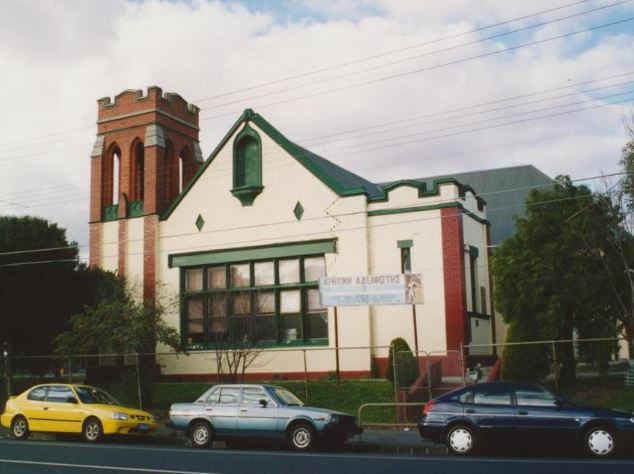
In the car I am disorientated and amazed. I am moving my head around to try catch a glimpse of everything outside the car window, trying to take it all in. Every street away from home seems to be populated by people I have never seen before, each living incomprehensible lives in unrecognisable houses. Even though I don’t recognise much outside the car, I recognise our destination. We drive into a slightly unkept property, comprised of a half-filled carpark and an imposing yellow brick building. On one side of the car park is a group of elderly men loitering around a BBQ, on the other side is a group of kids playing soccer. We park near the kids who scatter quickly at the sight of a moving car. As we get out of the car though, the kids are quick to resume their game, kicking the soccer ball against the wall of the brick building as we make our way to the entrance.
There are a few adults smoking outside and they all say hi to my parents. Dad introduces them to my brother and I, and we greet them all as Θείο and Θεία. I don’t know their names, and I’m pretty sure I’m not related to any of them, but that doesn’t matter, they are always Θείο and Θεία. The entry doors are flung open by a grumpy adult making his way outside, and I get my first glimpse of the inside the yellow building. There is a small tiled foyer and a wooden commemorative board hanging above the doorway to the main hall. The board commemorates the volunteers and donors who helped build this place. As I walk into the main hall, I walk underneath my Παππού’s name.
The hall is a vast uninterrupted space with dizzyingly high ceilings. The walls are painted yellow and the carpet is grey with orange and purple flecks. Pink chairs are stacked against the wall, dangerously high, and wooden laminate trestle tables are scattered everywhere, except on the central wooden dance floor. Along the back wall is a line of decorative red and black plaster columns, mimicking those at the ancient Minoan Palace. It’s a different kind of Greek here, and replica Parthenon columns don’t belong. The place is a bit of mess, filled with odd decorations and furniture, but also by a chorus of conversation emanating from a lively set of tables.
Several of the round trestle tables have been lined up alongside the dance floor and are filled with dozens of Cretans in their golden years. They are laughing and arguing over πιλάφι and lemon potatoes, basking in the sunlight that beams through the ceiling high windows, and also in the warmth of their lifelong friendships. There are plenty of other people here too. On the central dance floor a few quiet kids appear to be waiting patiently for something, and scattered around the hall are clusters of their English speaking parents. I jump onto the stage to get a better view of the hall, not the permanent stage that has been built into a recessed wall, but onto the temporary stage that seems to be in a different place every time I come here. The grumpy adult from before returns to the hall, followed a group of the cheeky kids who were playing outside. The grumpy adult addresses us kids on the dance floor, it’s time for dance practice.
The teacher lines us up on the dance floor and explains that today we will learn συρτό. He says that συρτό has twelve steps and begins to slowly walk us through them, counting in Greek, always in Greek. “Δέκα εντεκά! Ένα δύο τρία! Τέσσερα πέντε έξι! Επτά οκτώ εννέα! Δεκα εντεκά!” The teacher dances in front of us and we copy his steps, or at least most of us do. Some of the older kids look bored, some of the cheekier kids can’t concentrate, and my head darts from the teacher’s feet to the kids around me. It doesn’t help that the loud tables of elderly people are set up right next to the dance floor. Some of them are watching us with delight, calling out instructions to their grandkids, but most of them continue their noisy discussions. Noise comes from the kitchen too, as hair netted elderly people kick through the saloon style doors every few minutes with more πιλάφι and potatoes. Meanwhile a revolving cast of elderly men are frequently walking over to the bar, and sometimes behind it, to grab bottles of VB for themselves and wine for their wives. The teacher battles the cacophony of noise and continues to bark instructions at us until he’s confident that we’ve mastered the basic steps. Finally the teacher gives up the battle and splits up into groups to practice our φιγούρες.
I’m too young to get my φιγούρες straight away so I mostly watch the others practice. There are four φιγούρες all up today, Boys 1, Boys 2, Girls 1 and Girls 2, each one is different. Boys 1 involves stepping out of the main line rhythmically and finishing with a spinning jump, whereas the girls’ φιγούρες involve intricate footwork and coordinated spins. Boys 2 is my favourite though, and involves the boys jumping into the air and wildly slapping the soles of their feet, supported by partners, or where a partner isn’t available, by holding onto one of the hall’s pink chairs. As we each independently continue our φιγούρα practice our attention begins to deteriorate. Kids are jumping and kicking independently of any rhythm, the noise from the tables has grown so that chaos reigns in the hall. The dance teacher has had enough, and breaks up the class for a short break.
I run outside with the other kids in the glorious sun. One of the kids brings out his soccer ball suggesting we play the same game against the wall, but there are too many cars in the car park now. Another kid brings a tennis ball hoping to play down-square, but there’s too many of us to all get involved. We end up playing a mash up game of tiggy and hide & seek, amongst the discarded hard rubbish on the grassy area near the building entrance. It’s the perfect playground, complete with cracked trestle tables, broken pink chairs, a ripped trampoline and a discarded sewerage pipe big enough to sit in. It’s a lot of fun for us kids.
I could tell that these kids were different from the ones at school. Up until now I had always asked two questions when meeting someone. What is your name (My name is Μανώλη) and where are you from (I am from Greece). I quickly came to anticipate that everyone shared the same answer to the second question, but I was really surprised when I found someone who shared my answer to the first. I didn’t anticipate meeting another Μανώλη but I did. It was the first time I met someone else with my name, other than my Παππού. I was thrilled to be running around with kids who spoke my language, shared my story and could all pronounce my name with ease. Eventually though our play break came to an end and the teacher called us back onto the dance floor.
It was time for us to put together everything we had learnt. I knew the steps, I knew how to count and I knew both of my φιγούρες. Our teacher lined us up on the dance floor in order of height, and told us to hold hands, a strange and awkward concept which fueled bickering and chatter. However when the teacher hit play on the CD the λύρα and λαούτο masked the regular chaotic noises of the hall and the bickering was replaced with focus we began to dance. The lead boy at the front looked down the line like a shepherd watching over his flock, and the teacher similarly watched over the lead, making sure the delegated responsibility was adequately managed. The lead boy called the φιγούρες in turn and with each call we stepped up. For Boys 1 the boys moved forward rhythmically, for Girls 1 the girls spun in synchronicity. When Boys 2 was called the boys each turned towards their partners, clutched their hands for support, and hit their feet in the air, jumping higher with each repetition.
The dancing concluded and we could tell the teacher was satisfied with today’s effort. The teach shared final comments and just like that, our dancing lesson concluded and we returned to our patiently waiting parents. It was late in the day now and the elderly were enjoying coffee and cake, as their conversations about Greek, Club and Garden politics were to trailing off. As food was cleared from the table a tin was passed around and each person contributing some cash to cover the day’s events. It looks like everyone has volunteered here at one point or another, and everyone certainly had a different opinion as different sized contributions filled the donation tin. Before we left my brother and I had to day our good byes to seemingly everyone. We said by to the kids, teh Θείοs and Θείαs, and of course we said bye to our Γιαγιά who was picking up her empty cake tray and to our Παππού who sitting comfortably at the elderly table. As we left I turned back to the hall and caught a glimpse of my Παππού wrapping up a conversation with an old friend. He is old and he is happy.
 ehhere
Leave a comment